Our 2025 Gender Pay Gap report
Inclusion & Diversity at Evelyn Partners
To support the strategic priorities of our business, we believe it is essential to have an inclusive culture, where colleagues with diversity of background and thought are able to contribute towards our organisational success, and where our Practitioners are able to support and advise a wide range of clients.
An overview of the key aspects of our I&D Strategy follows our 2025 Gender Pay Gap results within this report. Please find our statutory Gender Pay Gap data at the bottom of this report.
“ I am pleased to present our Gender Pay Gap results for 2025. Following the sale of the Professional Services business - S&W - in March 2025, the information in this report shows our results on a like for like basis compared to prior year (comparing our stand-alone Financial Services results in 2025 to stand-alone Financial Services results in 2024). When comparing like for like results, we have continued to make good progress on our Gender Pay Gap results, which helps demonstrate our commitment to improving gender diversity, and continuing to develop a more inclusive culture. As well as publishing our gender pay results, this report also outlines some of the initiatives which help us achieve our inclusion and diversity ambitions. ”
Diversity in Financial Services
Having colleagues who reflect the diversity of our communities is of course the right thing to do, but we also believe it makes sound business sense. Reflecting the diversity of our actual and potential client base is critical if we are to continue to compete and successfully grow our business in the future.
However, the Financial Services sector still has challenges with diversity, particularly in senior roles, which has resulted in it making slower progress than many other sectors with measures like the Gender Pay Gap.
It is worth noting that a high Gender Pay Gap does not mean that colleagues are paid unfairly. It could mean that there are more men occupying senior, higher paid roles. The reality is that it is harder to impact diversity in senior roles in these sectors in the short to medium term due to a number of legacy factors such as:
- The Financial Services sector has traditionally attracted a higher number of men. It is becoming more diverse, but this is still the case
- Higher paid senior roles are usually underpinned by expertise developed over a long career and through established client relationships
- There is low colleague turnover in senior roles.
Through our Inclusion & Diversity (I&D) strategy, we are undertaking a wide range of activities which are focused on improving diversity not just in our business, but the wider Financial Services sector. Please see the 'Our strategy' section below for more details.
Our Gender Pay Gap Results
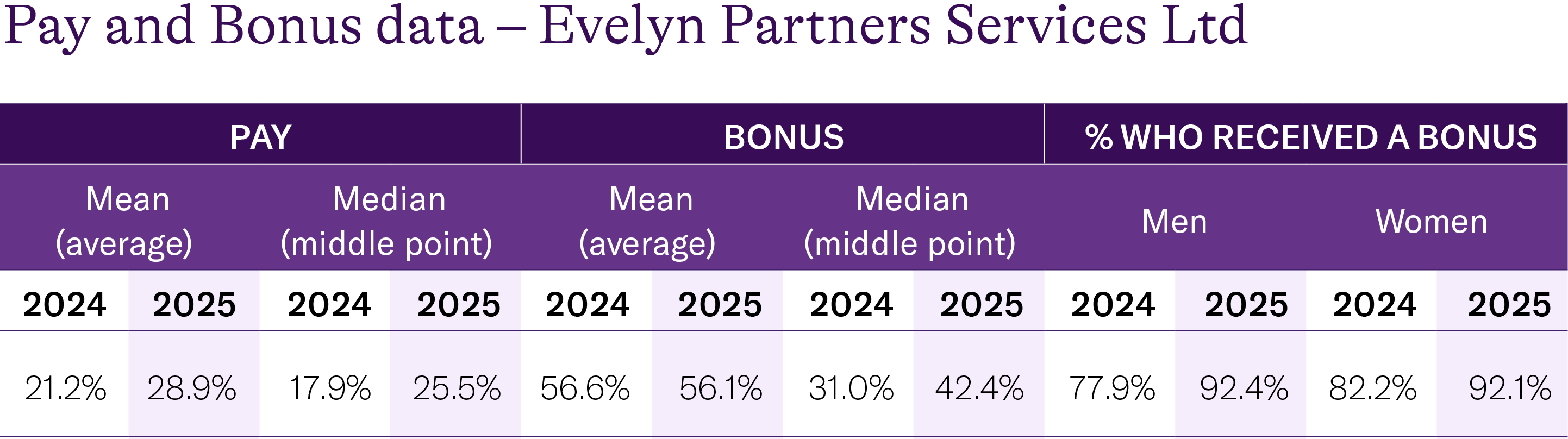
We continue to see progress on our gender pay gap results across all areas. The gender pay gap is defined as the difference in average earnings (mean and median) between women and men, regardless of the seniority of their role. Unlike equal pay, which refers to paying women and men the same amount for the same or similar work. At Evelyn Partners Group we are confident that the checks we have in place ensure we pay colleagues fairly (equal pay for the same or similar work).
Median Gender Pay Gap
Median Gender Pay Gap
Most companies focus on the Median Gender Pay Gap (Median GPG), as it removes the impact of extreme outliers, giving more consistent and comparable reporting from one year to the next. The median bonus gap is the difference between the median bonus pay of women and the median bonus pay of men, expressed as a percentage.
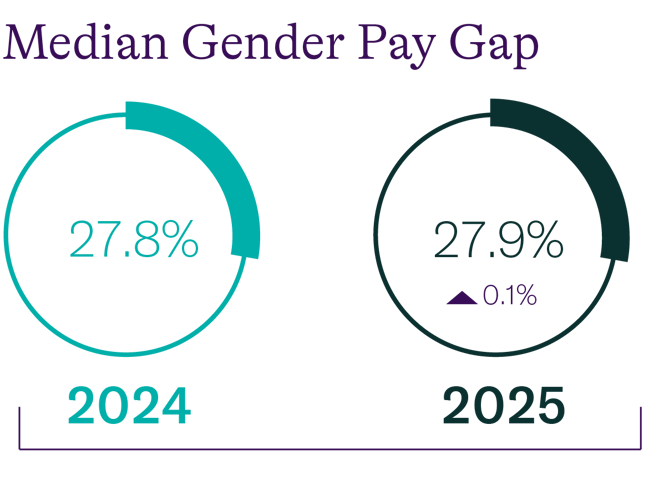
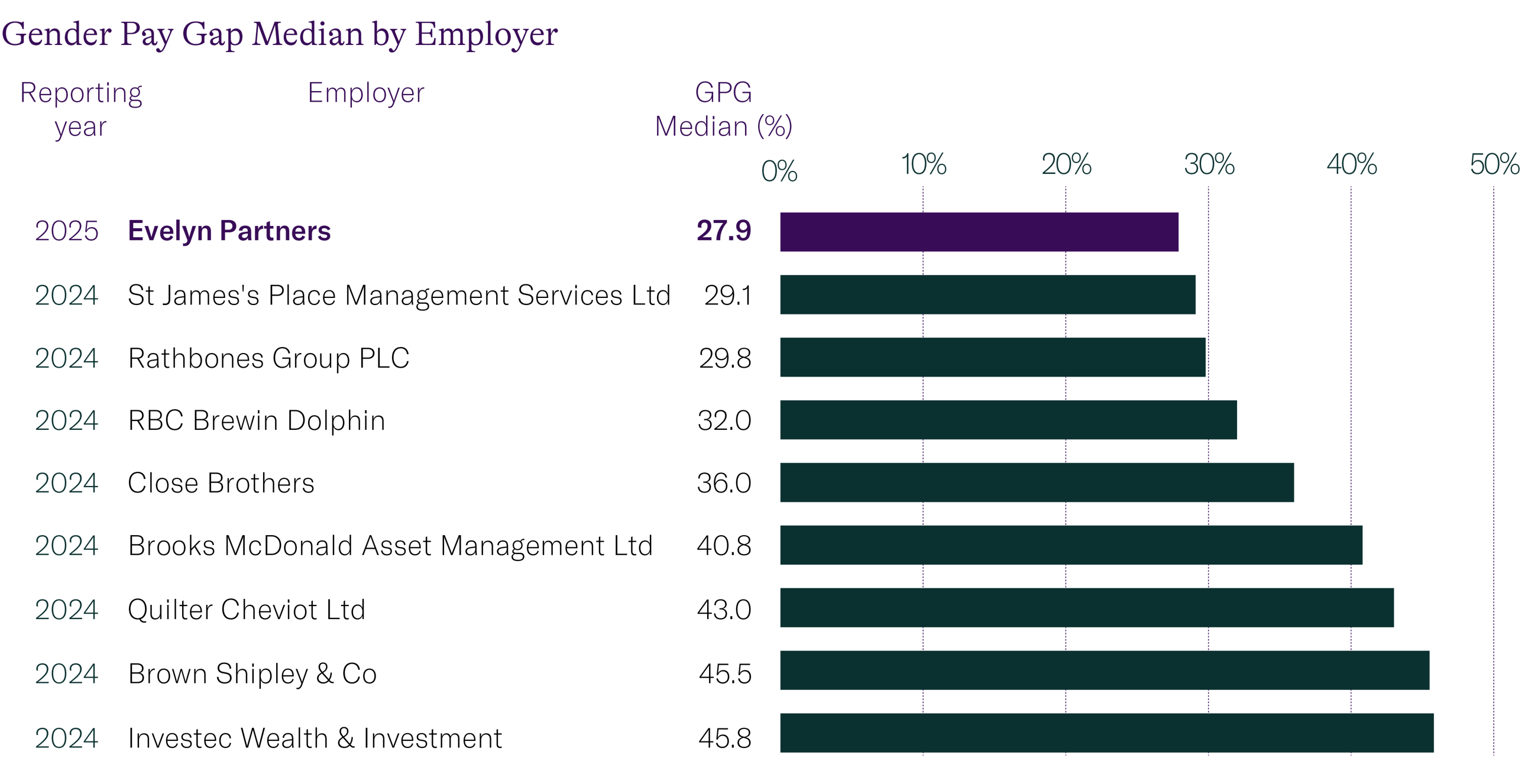
We achieved a median Gender Pay Gap of 27.9% for 2025 (as a Financial Services business), compared to 27.8% for the equivalent population in 2024.
Please note that having a gender pay gap does not mean that colleagues are paid unfairly, but rather because more men occupy more senior, higher-paid roles. This is because of legacy factors described earlier in the report.
Median Gender Pay Gap comparisons
Like us, most companies are due to publish their GPG for 2025 in early April 2026, so at point of publishing we only have 2024 data to compare to for some comparisons.
When looking at Evelyn Partners’ direct competition our GPG result 27.9% compares well with all of our competitors.
Gender Bonus Gap
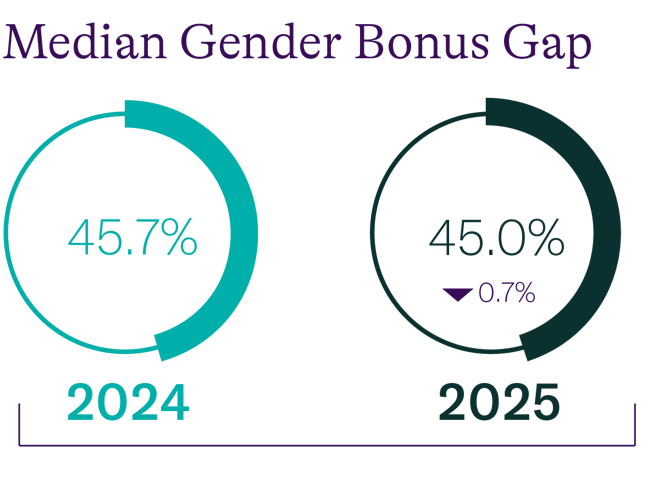
In addition to our Gender Pay Gap, we report our Gender Bonus Gap. The median bonus gap is the difference between the median bonus pay of women and the median bonus pay of men, expressed as a percentage.
Evelyn Partners median gender bonus gap has continued to improve. We achieved 45% for 2025, down from 45.7% in the previous year.
As with the median pay gap, this does not mean that colleagues are paid unfairly. It reflects that more men occupy roles which receive higher bonuses (e.g Senior Practitioner roles). This is because of legacy factors described earlier in the report.
Gender Pay Gap % of colleagues paid a bonus
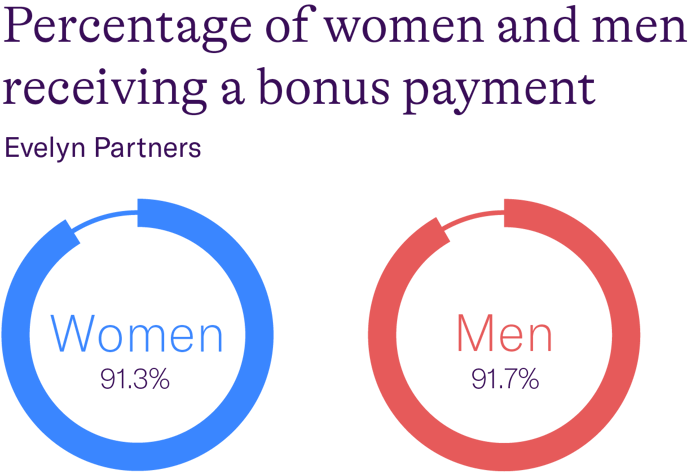
As part of the GPG we report on the percentage of women and men paid a bonus. For Evelyn Partners in April 2025 the percentage of women who were awarded a bonus was 91.3%, comparable with men, where the number was 91.7%. This demonstrates the fairness of approach we have in respect to reward.
Gender Mix
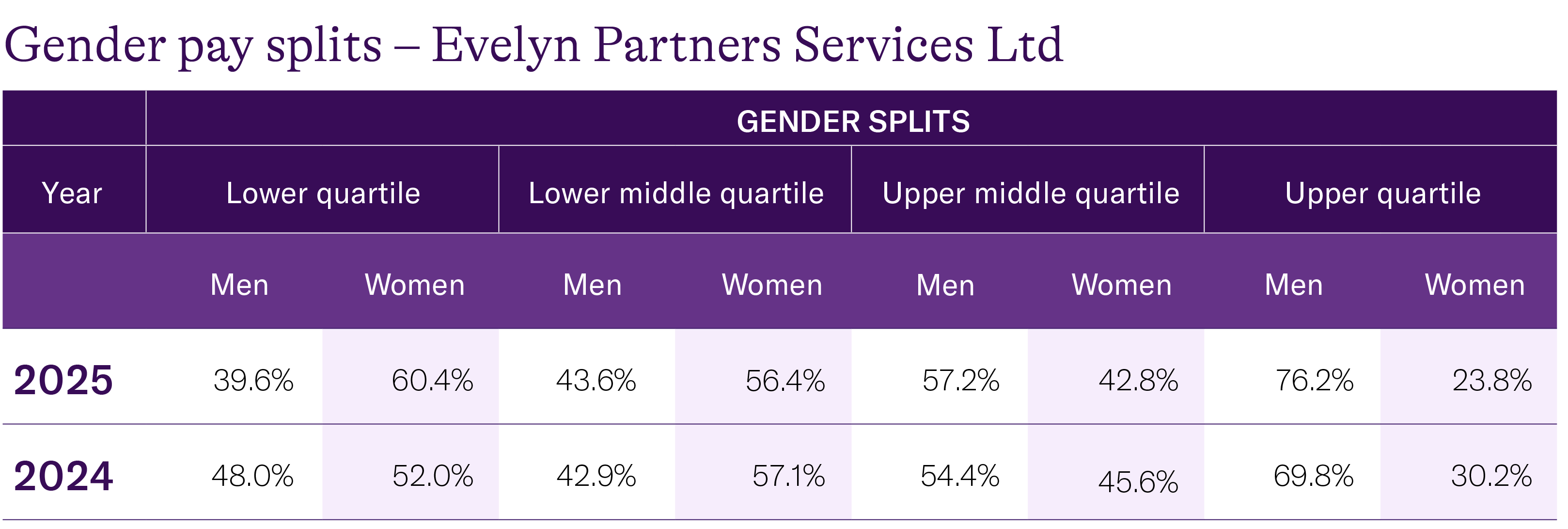
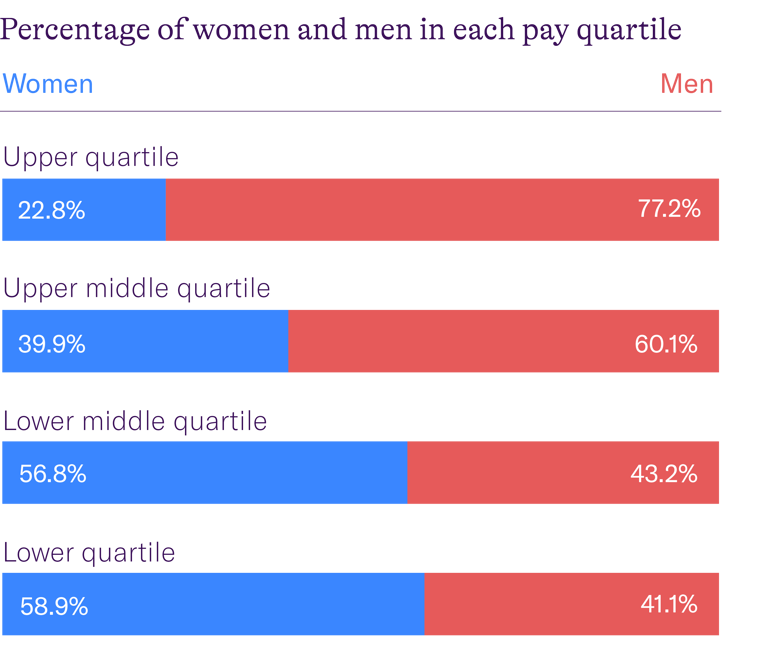
As part of our GPG reporting, we publish the mix of women and men at different pay levels (pay quartiles) across the organisation. Pay directly equates to the seniority of roles within the organisation.
As a result of our I&D strategy, Evelyn Partners have increased the percentage of women in the most senior roles (higher pay quartiles) year-on-year. The percentage of women in our upper pay quartile increased by 0.8% from 22% to 22.8% year-on-year.
We are committed to continuing to make progress on increasing the diversity of colleagues across the organisation, particularly at a senior level. However, bearing in mind the previously referenced legacy factors, we must also ensure that we are realistic in our ambitions.
Our I&D Strategy
Our I&D strategy can be simply summarised as: ‘to have a business which is both inclusive and diverse, reflecting our clients and broader society’.
Many things influence inclusion and diversity, but the key things we are focusing on are as follows:
- Accreditations and Industry Standards – benchmarking our I&D strategy and progress
- Measurement of culture and diversity – cultural colleague feedback and monitoring our diversity
- Culture and values – continuing to develop and embed an inclusive culture
- Colleague involvement – I&D Committee, Colleague Networks Groups, and Inclusion Champions
- Recruitment – ensuring we have a diverse candidate pool and remove bias from the recruitment process
- Learning and Development – including cultural training
- Benefits – comprehensive and competitive
- Policies – reviewed and benchmarked
- Communities – encouraging more diversity in Financial Services
“ Our colleagues continue to play their part by living our values every day in all that they do and behaving as allies to one another, thereby developing an inclusive culture which we can all be proud of, and for that I am grateful and thankful to each of them. ”
Industry standards and accreditation
Inclusive Employers Standard
We believe it is important to have an independent and expert measure on how much progress we are making in relation to our I&D strategy. I am pleased we hold the silver accreditation, which reflects our commitment to embedding workplace inclusion and diversity.
The standard requires us to evidence what we currently do and looks for companies to demonstrate that inclusion is integral to their organisation. We will continue to undertake regular reviews of our I&D strategy with the aim of achieving a gold accreditation in the future.
Women in Finance Charter
The Women in Finance Charter is a pledge for gender balance across Financial Services. The Charter, in short, asks Financial Services firms to commit to implement four key industry standards:
- Having one member of the senior executive team who is responsible and accountable for gender diversity and inclusion;
- Setting internal targets for gender diversity in senior management
- Publishing progress annually against these targets; and
- Having an intention to ensure the pay of the senior executive team is linked to delivery against these internal targets on gender diversity
Evelyn Partners is committed to working towards greater female representation within our industry, particularly within senior management roles.
When we signed up to the Charter in June 2022, we had 26% female representation in senior management and our target was 30% by December 2025. As of June 2025, we have 26.5% female representation in senior management, which is still commendable despite the sale of our Professional Services business and resultant reduction in headcount. Due to the significant change in our headcount as a result of selling the Professional Services business, we have revised our target date to achieve 30% female representation in senior management by December 2027.
Measurement
Culture - gathering colleague feedback
We undertake regular Colleague Pulse Surveys (CPS), usually twice a year. The feedback we get from our colleagues is incredibly important and directly informs the evolution of our I&D strategy.
Within our CPS, in addition to a range of questions on colleague engagement, we have specific questions relating to our culture and whether colleagues feel Evelyn Partners is an inclusive place to work. The questions include whether our colleagues understand and believe in our values, whether they feel they are treated fairly, whether colleagues feel they can be their true selves at work, whether their contribution is valued and whether there are equal opportunities at Evelyn Partners.
Colleagues also have the opportunity within the CPS to make additional comments which provide further insight. We are proud that the questions relating to our values and culture are consistently some of the highest-scoring within our survey. However, we continue to strive for improvement based on the insight that the survey gives us.
Monitoring diversity
We measure a range of key performance indicators relating to diversity at every stage of the colleague journey. This includes diversity within candidate pools and new starters, the diversity across the organisation in total and at different levels of seniority, and within different teams and committees. To support this, the majority of our colleagues generously opt to provide us with their personal profile data voluntarily, which allows us to look at this across different types of diversity in addition to gender, including ethnicity, social background and sexual orientation, to name just a few.
Culture and values
Having diversity across our colleagues is important, but we are conscious that having diversity without an inclusive culture means that our business might not be benefiting from the diversity we have. Colleagues need to be their true selves in the workplace if a business is to benefit fully from their diversity of thought and background. So having a culture which is inclusive is at least as important as having diversity.
As part of our I&D Strategy we are committed to continuing to develop and embed an inclusive culture. An important part of this is our values, which are:
- Personal — we treat you as an individual
- Partnership — we go further together
- Performance — we strive for more
To ensure we embed our values within the business and that clear expectations are set, all colleagues are appraised on their behaviours. This assessment is underpinned by our values and forms 25% of everyone’s annual discretionary bonus.
Colleague involvement
Inclusion and Diversity Committee
Our Inclusion and Diversity Committee was established mid-2020 with a primary purpose to provide a forum by which colleagues can contribute ideas to I&D strategy development and identify ways in which colleagues can be engaged in executing and supporting the I&D agenda across the organisation.
Colleague Network Groups
Along with our colleague Network Groups, who are empowered to arrange inclusion events and activities across a wide range of topics. We now have several Network Groups bringing together underrepresented groups for support and allyship:
- Gender Equality
- Family
- Proud
- Social Mobility
- Able
- RaRE – Race, Religion and Ethnicity
Inclusion Champions
Inclusion Champions help us achieve our ambition of creating a more inclusive culture by being role models for inclusive behaviours and reducing, or removing, the bias and discrimination that our colleagues may face. They do this by spreading awareness about Network events and promoting inclusive behaviour in the team(s) around them. Our Inclusion Champions support the execution of the I&D strategy across our office footprint, ensuring all colleagues, no matter where they are, have an opportunity to be involved.
Allyship
We have emphasised the importance and role of allyship from all colleagues in our communications.
Recruitment
We have focused on attracting a diverse range of candidates by developing a Employee Value Proposition (EVP) which represents our culture, values and I&D ambitions. This is being leveraged within our recruitment website and other forms of candidate communications.
The language within our job adverts and job descriptions is reviewed to ensure we're using inclusive language and have the best chance of attracting candidates from diverse backgrounds.
When recruiting we target having at least half of the candidates put forward coming from diverse backgrounds, to give ourselves the best opportunity of the right person for the role.
Learning and Development
Induction
Our induction for new joiners focuses on our purpose and values, ensuring all colleagues understand our culture and how important I&D is within our business.
Ongoing mandatory training
A wide range of training and development is available to our colleagues to support an inclusive culture, including interview skills and leadership development, to name a few. We have undertaken mandatory training including Harassment Prevention, Conscious Inclusion, Microaggressions and Anti-Sexual Harassment training.
Benefits
We regularly review and benchmark all of our benefits to ensure they are competitive compared to the market and support our I&D ambitions. Our suite of benefits includes:
- Pension Scheme, including enhanced Company pension contributions,
- Income Protection
- Life Assurance
- Private Medical Insurance
- Holiday
- Employee Assistance Programme
- Eyecare and eye tests
- Long Service Award
- Money Health (financial guidance)
Optional benefits which include
- Private Medical Insurance for family members
- Critical Illness Insurance
- Travel Insurance
- Dental Insurance
- Partner Life Assurance
- Health Cash Plan
- Health Assessments
- Personal Accident Cover
- Additional holiday
Other
- Cycle to work scheme
- Season ticket loans
- MyGym discounts
- Will Writing discounts
- Mortgage Advice
- Give as you earn
Policies
We have a comprehensive suite of policies which have been developed and annually reviewed to ensure we are doing all that we can as a company to support our I&D ambitions, These include:
- Equality, Diversity and Inclusion Policy
- Family Leave Policy
- Flexible Working Policy
- Hybrid Working Policy
- Dignity at Work (Anti-Bullying and Harassment) Policy
- Dignity at Work (Anti-Sexual Harassment) Policy
For example as part of our Family Leave Policy we offer 26 weeks enhanced and shared Parental Pay, as well as Adoption Leave, so colleagues are supported when choosing to have a family. We offer hybrid and flexible working and monitor colleagues' return to work closely so we can provide support.
Community
We understand that increasing diversity in senior roles and closing our GPG is not something we will achieve overnight given the challenges which exist in attracting people from diverse backgrounds into the Financial Services sector. As such, we are investing and supporting charities that encourage females and underrepresented groups from all backgrounds to consider careers in Financial Services.
We participate in industry initiatives such as GAIN (Girls Are Investors), to enable our role models to showcase their stories and mentor young people through internships, who typically would not be exposed to these types of careers.
Our corporate charity partner, Career Ready, aim to boost social mobility by empowering young people and giving their talents a platform to flourish from. They work with young people, schools, and colleges who face the barriers in education and employment which cause their talents to often go undiscovered. Career Ready boost social mobility by delivering a structured programme of mentoring and a paid internship, masterclasses, and workplace visits for young people from under-represented backgrounds. which provides a number of volunteering opportunities for our colleagues.
Gender Pay Gap
Background
All UK firms with 250 or more employees are required to report their gender pay gap analysis on an annual basis using the following metrics:
- mean gender pay gap
- median gender pay gap
- mean bonus gender pay gap
- median bonus gender pay gap
- proportion of men and women receiving bonuses
- proportion of men and women in each pay quartile
Gender Pay Gap data
The data provided here relates to the twelve months preceding 5 April 2025.
In the interests of transparency, we are going beyond the mandatory requirements set out in the Government’s gender pay gap reporting legislation and once again publishing figures covering all of Evelyn Partners colleagues.
Following internal restructuring and rationalising of employing entities, most of our colleagues are now employed by Evelyn Partners Services Limited, which means we only have one entity that employees over 250 colleagues.