


AI is evolving from a niche domain into a general-purpose technology reshaping the global economy. This transformation is being powered by cheaper computation, abundant data, and rapid algorithmic advances.
However, as AI scales, so does its demand for electricity, water, and essential infrastructure, creating tensions with local communities, environmental advocacy groups, and technology companies’ own climate targets.
AI is therefore creating a paradox: it is simultaneously a major source of new energy demand and one of the most promising tools available to accelerate decarbonisation.
Gauging AI’s environmental footprint
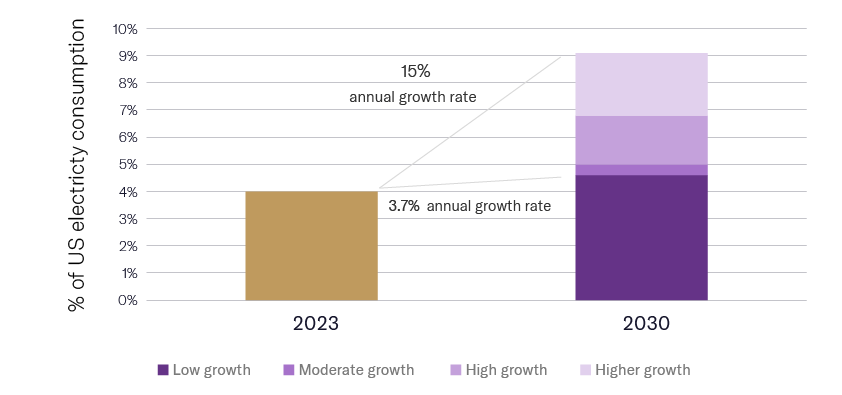
Modern AI data centres can be highly energy intensive, with electricity generation required to supply data centres set to more than double to over 1,000 TWh in 2030.1 In the US, data centres already accounted for roughly 4% of national electricity consumption in 2023, and this could rise to 9% by 2030.2
Figure 1: AI data centre electricity consumption set to rise in the years ahead
Source: EPRI (2024) “Powering Intelligence, Analyzing Artificial Intelligence and Data Center Energy Consumption”
A key concern is carbon lock-in. Meeting 24/7 power needs in the near term often requires natural gas generation. While the IEA expects renewables to supply almost all incremental data centre electricity demand between 2030-2035, near-term deployment constraints mean that natural gas and coal are projected to account for about 40% of additional demand up to 2030.
Water use is another concern. Cooling high-performance servers can require substantial freshwater; globally, AI-related demand could drive 4.2–6.6bn m³ of water withdrawals by 2027, roughly half of the UK’s annual consumption. Additionally, around 45% of data centre capacity sits in regions already facing high water stress.3
How carbon and water intensive are data centres in context?
Despite rising emissions, data centres remain far less carbon intensive than high-emitting industrial sectors. Mining and basic materials companies often have 10–20× higher carbon intensity than major semiconductor and cloud providers. Even the carbon intensity of a pure-play data centre operator such as Equinix amounts to less than 7% of that of Rio Tinto, a mining company.
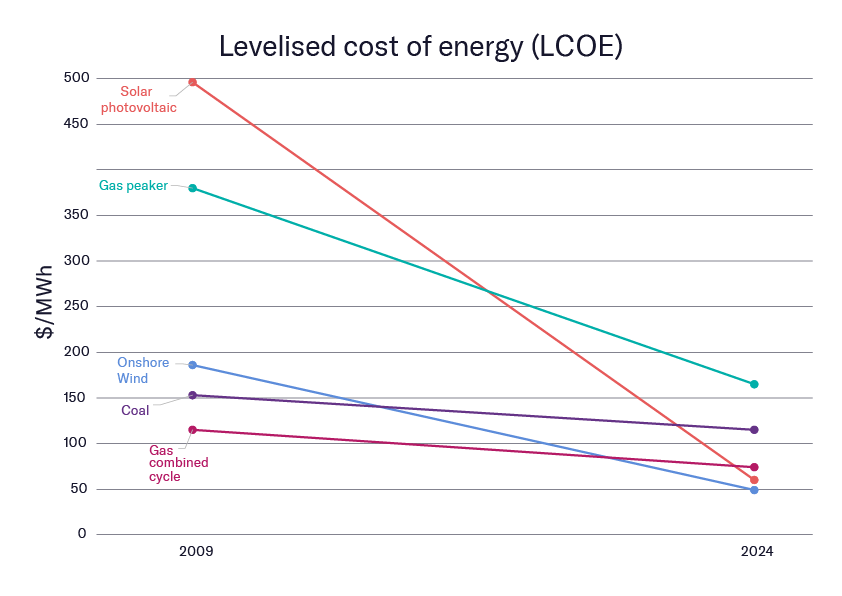
Meanwhile, AI demand is arriving at a moment when renewable energy economics are improving rapidly: in the US, solar paired with batteries is now cheaper than coal and nuclear. In 2025, renewables accounted for 88% of all new US generating capacity, with the share expected to keep rising.4 Nuclear small modular reactors and advanced geothermal, are emerging as longer-term solutions for meeting AI-driven baseload demand. Advancements in fusion look equally promising, with Google securing 200MW of clean power from the world's first grid-scale fusion power plant scheduled to come online in the early 2030s.
Figure 2: Renewable energy is increasingly cost competitive
Source: Our World in Data as of April 2025.
Some water use concerns may also be overstated, as different measurement approaches can blur the scale of the issue. For instance, a recent study showed that a 400 MW AI-oriented facility consumes around 346 million gallons per year, only roughly 2.5 times the total water footprint of a single burger restaurant when taking the full water supply chain usage into consideration.
To be sure, the underlying concern is not being disputed: water demand is rising in the wrong places at the wrong time. However, with one-third of global water never reaching end-users, broader infrastructure inefficiencies also remain part of the problem.
AI as an enabler: the route towards positive net impact
AI’s path from environmental burden to sustainability tool is unfolding through several channels.
i) Efficiency gains in hardware and computation
AI hardware is getting dramatically more efficient, with the energy efficiency of leading AI computing chips improving by roughly 40% a year.5 Nvidia’s next-generation Vera Rubin system is expected to use about twice as much power as its predecessor while delivering 10 times the performance per watt.6
At the data-centre level, new power architectures are also improving efficiency by reducing electricity losses across conversion stages.
On the software side, research shows that practical changes, such as reducing numerical precision, shortening responses, and using smaller, specialised models, can cut AI energy use by up to 90% without meaningfully reducing accuracy.7
Although efficiency gains can increase usage in some areas, AI demand is unlikely to be infinitely elastic as organisations begin balancing performance improvements against rising infrastructure and energy costs.
ii) Hyperscaler environmental commitments and innovations
Major technology firms are also investing heavily in lower-carbon and more resource-efficient infrastructure. Google, for instance, has committed to running all its data centres and campuses on 24/7 carbon free energy by 2030.
Hyperscalers are also working toward becoming net water positive, investing heavily in closed-loop cooling systems and water infrastructure upgrades. These commitments have already produced measurable improvements. Microsoft has reduced its data centre Water Usage Effectiveness by 39% since 2021, while Amazon has committed up to $400 million to upgrade public water infrastructure in Louisiana as part of a broader $12bn data centre investment.8,9
Although critics argue that externalities are immediate while benefits are prospective, it is difficult to dismiss the scale of real progress driven by these investments.
iii) AI applications that accelerate decarbonisation
The complexity, interdependence, and data intensity of sustainability issues make them an ideal domain for AI to add meaningful value.
In electricity systems, AI-enhanced forecasting and grid optimisation could unlock 175 GW of transmission capacity without building new lines, according to the IEA. Across heavy industry, widespread use of AI for predictive maintenance, robotics, and process optimisation could deliver energy savings equivalent to Mexico’s annual consumption.
In aviation, AI-based routing tools can reduce contrails, which account for 35% of aviation’s climate impact. American Airlines has already reported a reduction of 62% in contrails on flights using Google AI’s predictive tools. In agriculture, AI powered precision farming applications help optimise fertilisation, irrigation, and treatment of crops, addressing chronic overuse of water and chemicals.
Where does this leave us?
AI’s footprint is undeniably growing, yet over time the dial could turn from burden to solution. Even under rapid-growth scenarios, AI data-centre emissions are expected to amount to less than 1.5% of global emissions by 2035, while, by contrast, AI-enabled optimisation could reduce global emissions by roughly 5% over the same time period. 10,11
Rather than undermining the energy transition, AI is reinforcing the economic case for clean energy, electrification, and digital infrastructure. Grid operators, electrical equipment manufacturers, and renewable energy developers appear particularly well- positioned to benefit.
For investors and policymakers, the challenge will be managing AI’s near-term energy and water demands while ensuring infrastructure and regulation evolve alongside the technology. With careful planning, AI can evolve from a resource strain into a powerful catalyst for a cleaner, more efficient global energy system.
Sources
3 Beneath the surface: Water stress in data centers | S&P Global
4 Renewable energy accounts for 88% of new U.S. electrical capacity in 2025
5 Epoch AI, October 2024: Leading ML hardware becomes 40% more energy-efficient each year
6 First look at Nvidia’s AI system Vera Rubin and how it beats Blackwell
8 2025 Microsoft Environmental Sustainability Report
9 Amazon to invest $12 billion in first data center campuses in Louisiana


