Flying through a Copilot jobs market

Artificial intelligence is changing how businesses operate, although its long-term effects on employment and economic activity remain uncertain. Here we review current evidence on labour market trends and productivity in the US

20 Jul 2026
co-pilot-article-banner.png

As artificial intelligence (AI) moves from novelty to necessity, investors are increasingly asking whether the US economy can fly through the transition to an AI-enabled workforce or whether widespread job losses will create turbulence. The central question is whether AI will destroy jobs faster than it creates them. If so, weaker consumer spending, slower economic growth and lower corporate earnings could weigh on risk assets. Yet the evidence suggests fears of a broad AI-driven employment shock may be overstated for three reasons.

1. AI-related job losses are not that significant

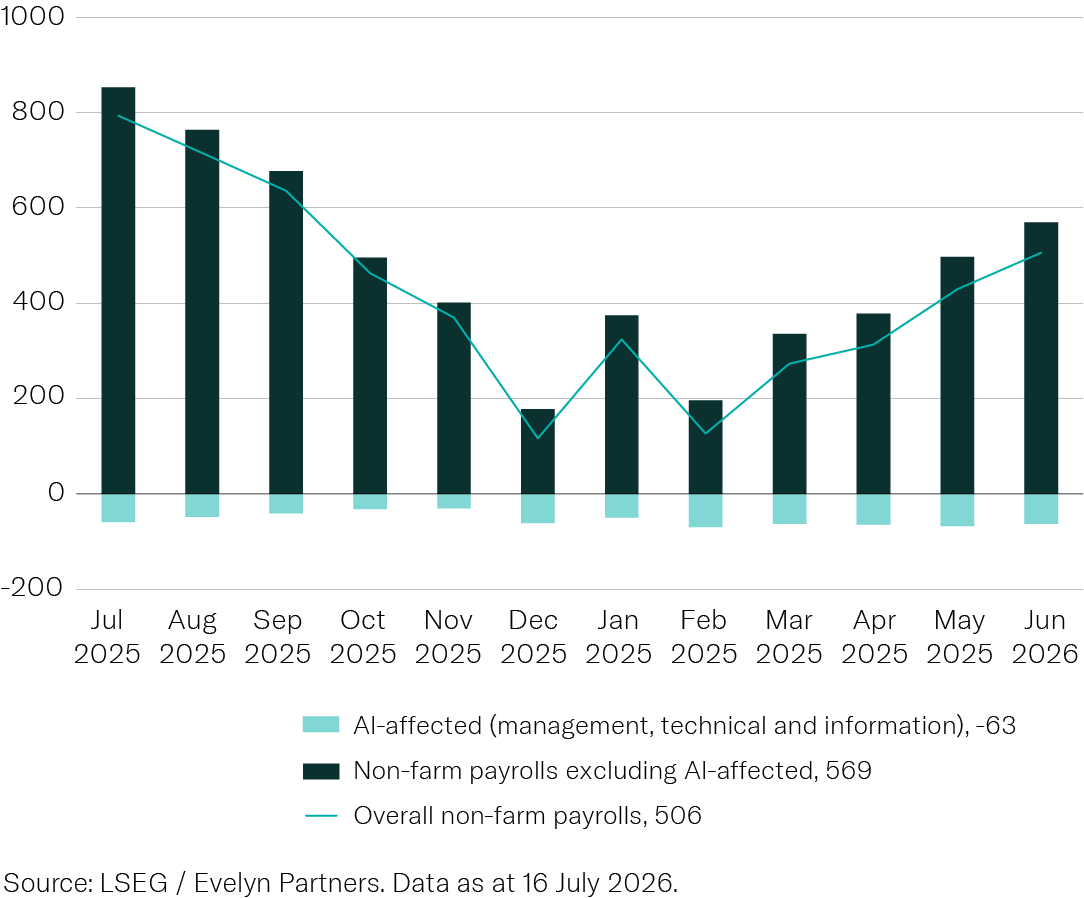
While uncertainty remains over which occupations will be most affected by AI, the initial impact in the US appears concentrated in information services (e.g. web hosting) and professional and business services (e.g. legal services and advertising). These AI-sensitive sectors have lost roughly 63,000 jobs over the past year, compared with 569,000 jobs being added to the rest of the economy.1

ai related jobs

This data suggests that AI is influencing hiring in specific industries, but it is not causing a broad-based US labour market disruption typically associated with a recession. One explanation may be that, despite rapid progress, businesses have yet to identify AI applications that deliver transformative productivity gains across entire organisations on the same scale that Microsoft Office has.

Even over the next several years, any labour displacement is likely to be concentrated in routine white-collar roles such as customer service and back-office functions. These occupations account for roughly 5% of the US workforce, suggesting the overall economic impact should remain manageable.2

2. Labour is cheap and profitable

Businesses are already using AI and automation to improve productivity, reduce costs and manage staffing efficiently. This is reflected in the labour-compensation share of US GDP, which fell to a record low of 50.5% in the first quarter of 2026.3 At the same time, globalisation and technological advances have reduced workers' bargaining power, allowing companies to retain a greater share of economic output.

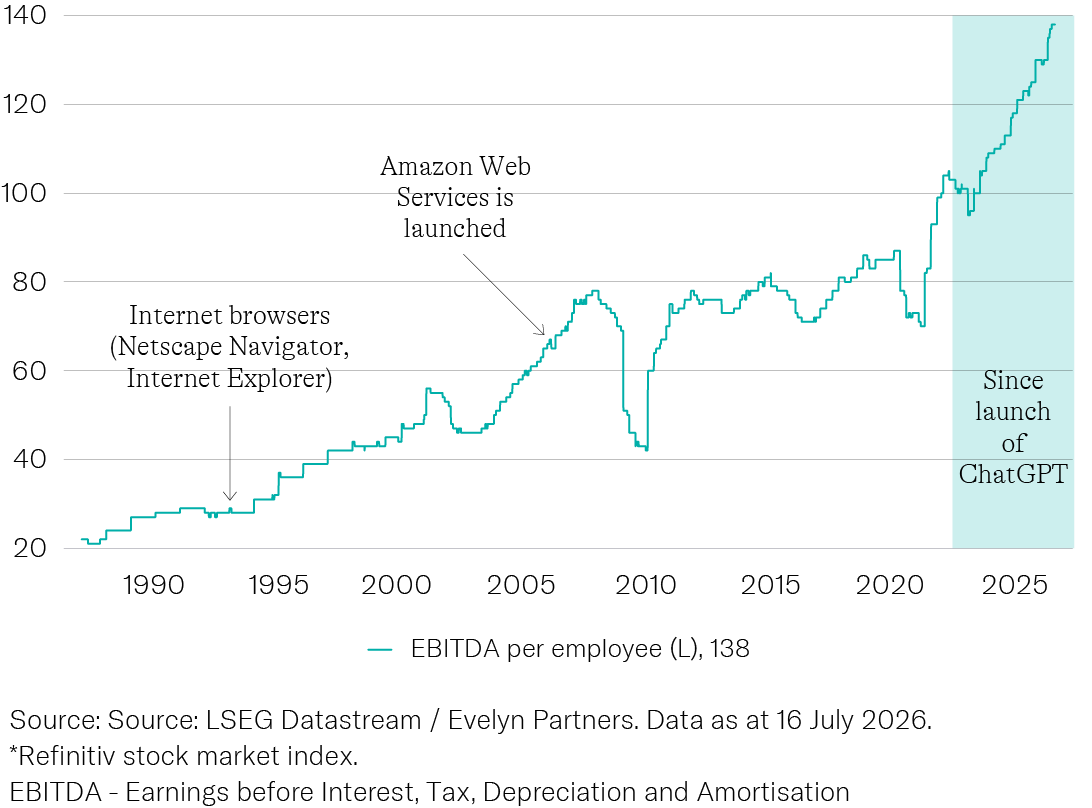
More importantly, the financial evidence suggests workers are becoming more valuable, not less. Over the past year, the underlying profits (measured as earnings before interest, tax, depreciation and amortisation) per employee of US-listed companies rose by 10.7% over the last year.4 This compares to the average 30-year annualised growth rate of 4.4% leading up to the launch of ChatGPT in November 2022.5 The emergence of generative AI tools, such as ChatGPT, has likely contributed to these profitability gains by enabling employees to produce more output with the same amount of labour. As AI boosts worker productivity and profitability, companies often have a greater incentive to expand their workforce than reduce it.

us stock market profitability

3. New jobs tend to replace old ones

History shows that technological change creates new jobs even as it makes others obsolete. Research from MIT estimates that 59% of jobs in the US today did not exist in 1940.6 Data from the same study indicates that 84% of employment growth between 1940 and 2018 came from newly created occupations rather than the expansion of existing ones.7

AI is likely to follow a similar path. It is already driving investment in data centres, digital infrastructure, cybersecurity and energy production.

Just as personal computers, the internet and smartphones created millions of jobs that were difficult to imagine beforehand, AI is likely to generate new occupations and industries that are difficult to predict today but obvious in hindsight.

Investment implications

Taken together, the evidence suggests the labour market is more likely to adapt to AI than be overwhelmed by it. Rather than triggering widespread unemployment, AI adoption is likely to result in a gradual transition, with some roles declining, others expanding and new occupations emerging over time.

The investment takeaway is that AI's greatest economic impact may come not from reducing the number of workers, but from increasing what each worker can produce. Rather than grounding the economy, AI is more likely to help it fly higher, supporting earnings, growth and risk assets over the long run.

Sources:

1,3,4,5 LSEG/Evelyn Partners

2 Goldman Sachs, Top of Mind, An AI job apocalypse, June 2026

6,7 Blueprints Labs, New frontiers: the origins and content of New Work, 1940-2018, December 2023