
Investment Outlook: Life begins at 250 for the US
A monthly round-up of global markets and trends
A monthly round-up of global markets and trends
As the US marks its 250th anniversary, its economic foundations remain strong, underpinned by innovation, deep capital markets and resilient institutions. Higher interest rates and policy uncertainty may contribute to periods of volatility, while earnings growth and investment linked to artificial intelligence (AI) continue to influence the longer-term outlook. In emerging markets, particularly across Asia, semiconductor companies are also benefiting from AI-related demand, contributing to strong earnings growth in parts of the region.
They say life begins at 40. For the US, it may begin at 250. As the US celebrated the 250th anniversary of its founding in July, the milestone offers an opportunity to reflect on whether the country's strongest years may still lie ahead. Indeed, relative to many of the world's oldest countries, the US remains surprisingly young. For instance, Japan traces its origins back more than 2,600 years, France more than 1,180 years, Spain more than 530 years, and the Netherlands nearly 450 years.
Despite its relatively short history, the US has established itself as the dominant force in the global economy and financial markets. Its large and dynamic domestic economy has provided a powerful foundation for sustained growth. Importantly, this economic success has been accompanied by a marked rise in real gross domestic product (GDP) per capita, indicating that the gains from expansion have increasingly translated into higher living standards than those achieved in many European peers. This combination of economic scale, innovation, and rising prosperity has helped underpin the economy's long-term resilience.
More importantly for investors today, there are few signs that the US economy is running out of road. The latest July economic forecasts from the IMF show that US real GDP is expected to expand by an average of around 2.3% for 2026 and 2027, compared to roughly 1.2% for the UK, 1.0% for the Eurozone and 0.7% for Japan for the same period.<sup>1</sup> In other words, the US is expected to continue outpacing many of its developed-market peers, reinforcing the view that its growth story is far from over.
A combination of political stability, strong property rights, and the rule of law have provided a durable foundation for investment and entrepreneurship. Indeed, the US Constitution, ratified in 1788, remains the world's oldest written national constitution still in force.
Building on this institutional foundation, the US has benefited from a remarkable capacity for innovation. The country invests around 3.5% of GDP in research and development, above the OECD average of 2.9%, helping to drive technological progress and productivity growth.2 Deep capital markets adds another layer of support for growth and a business culture that embraces risk-taking and rewards success.
Geography has also played a crucial role. The US possesses abundant farmland, extensive inland waterways, access to both the Atlantic and Pacific Oceans, and vast energy resources. Today, it is the world's largest producer of oil and natural gas. Apart from the attack on Pearl Harbor in 1941 and the terrorist attacks of 2001, its location has provided a degree of insulation from external threats, helping to support economic expansion compared with countries that experienced the devastating effects of two world wars on home soil.
Yet natural advantages alone do not explain America's sustained success. Its large domestic market has enabled businesses to achieve scale quickly and efficiently. Furthermore, the US dollar's status as the world's leading reserve currency has enabled the country to run sizeable budget deficits, supported in part by continued foreign demand for US assets.
Taken together, these advantages help explain why the US has repeatedly adapted to major economic and technological shifts, from industrialisation and the rise of the internet to the development of AI. The result has been a powerful engine of growth, innovation and wealth creation, which has translated into strong long-term returns for investors.
Economic strength matters for investors only if it ultimately translates into corporate profitability. Since the end of the Global Financial Crisis (GFC) in 2009, the US economy has generally expanded faster than other advanced economies. US GDP has grown from around 50% of the combined GDP of other advanced economies during the GFC to approximately 80% today.3 Over the same period, earnings per share (EPS) growth for US companies has beaten that of their peers in other MSCI indices by around 6 percentage points per year.4
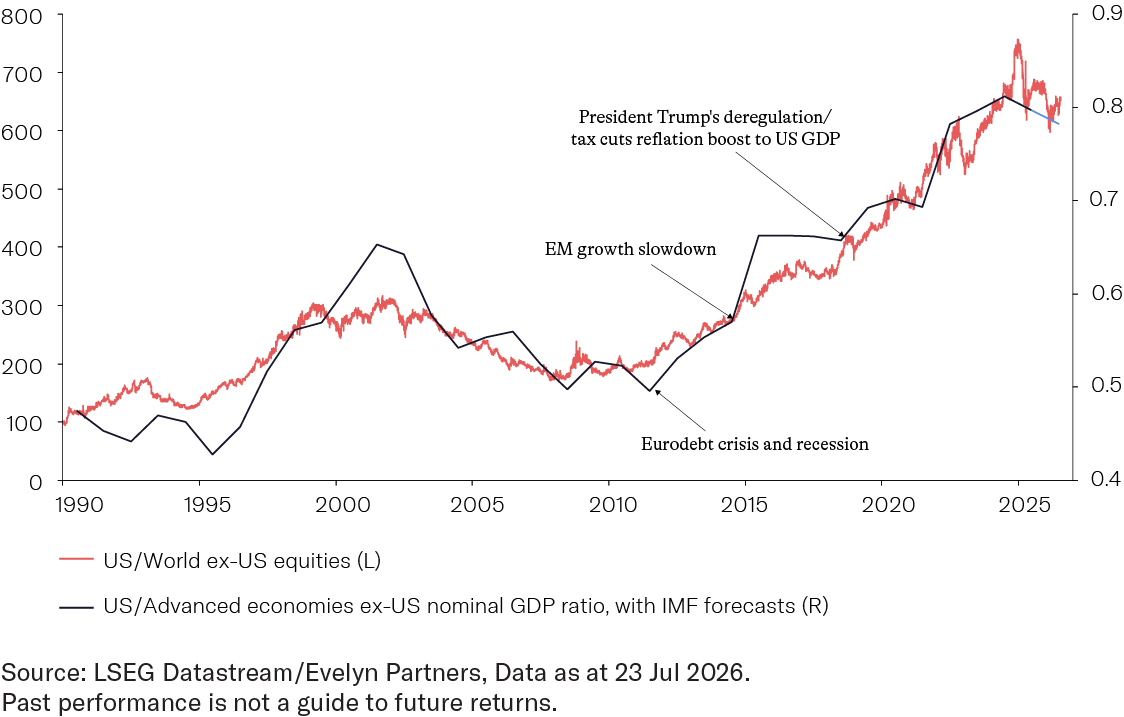
Superior economic growth does not always translate into stronger relative earnings growth in the short term. While US EPS is expected to grow by a still robust 24% in 2026, it trails the 33% growth forecast for companies in the MSCI All Country World Index ex-US.5 However, earnings expansion has been a key driver of US equity market outperformance relative to other developed markets over the long term. According to analyst consensus forecasts, US companies are once again expected to deliver faster EPS growth than other regions in 2027 and 2028.
Strong long-term fundamentals do not eliminate shorter-term risks. While the long-term outlook for the US economy remains compelling, investors must weigh these strengths against shorter-term risks. For instance, policy risk from the White House has increased, with President Trump's shifting positions on Iran and trade tariffs contributing to market uncertainty. Concerns about potential political interference in the Federal Reserve’s (Fed) decision-making have also raised questions regarding the future independence of monetary policy.
Reflecting these issues, investors may need to adjust towards a "higher-for-longer" interest rate outlook, with resilient US economic growth and sticky inflation reducing the likelihood of near-term Fed interest rate cuts. Higher rates may weigh on equity valuations, particularly in the technology and communication services sectors that dominate US markets. Tighter financial conditions have been a slight headwind for US equities this year.
None of this fundamentally weakens the long-term investment case for the US. Rather, it highlights the distinction between attractive structural fundamentals and shorter-term market risks. While the US remains the global leader in innovation, productivity and earnings growth, investors may face periods of volatility as markets adjust to changing interest-rate expectations, geopolitical developments and policy uncertainty.
A positive outlook for the US need not imply a US-only investment strategy. Given some of the risks associated with the US, investors may wish to look further afield for opportunities. At the same time, strong US growth, and particularly investment linked to AI, continues to create opportunities beyond its borders. As discussed in last month’s Investment Outlook (Investors and firms just can’t get enough of AI), massive spending on artificial intelligence is driving a sharp rise in the market valuations of technology companies globally.
This is becoming particularly evident in Asia, where semiconductor manufacturers have emerged as some of the world's most valuable companies. TSMC, Samsung and SK Hynix now account for roughly 30% of the Emerging Markets (EM) index.6 These firms have become central to the rollout of AI data centres, creating strong demand for semiconductors and driving rapid earnings growth. As a result, consensus forecasts suggest EM EPS will grow by 62% in 2026 and 24% in 2027, the fastest rates among the major regions, before moderating to 10% in 2028.7 This improving earnings outlook has helped support EM equities, with the MSCI EM index returning 20% (as at 22 July 2026) and outperforming developed markets so far this year.8
The US economy continues to benefit from many of the same strengths that have supported its success over the past 250 years: innovation, strong institutions, deep capital markets and an ability to adapt to change. These advantages continue to underpin earnings growth and help explain why US markets remain so important to global investors, while also creating opportunities in Asia.
If life truly begins at 250, the US may still be in the early chapters of a remarkably successful economic journey. For investors, however, the opportunity is not simply to follow that story, but to identify the winners emerging across all the markets and industries it helps shape.
1,3,4,5,7,8 LSEG/Evelyn Partners
2 OECD, Main Science and Technology Indicators (MSTI), OECD. Stat database, R&D expenditure (GERD).
6 Bloomberg/Evelyn Partners
Past performance is not a guide to future performance.
Neither MSCI nor any other party involved in or related to compiling, computing or creating the MSCI data makes any express or implied warranties or representations with respect to such data (or the results to be obtained by the use thereof), and all such parties hereby expressly disclaim all warranties of originality, accuracy, completeness, merchantability or fitness for a particular purpose with respect to any of such data. Without limiting any of the foregoing, in no event shall MSCI, any of its affiliates or any third party involved in or related to compiling, computing or creating the data have any liability for any direct, indirect, special, punitive, consequential or any other damages (including lost profits) even if notified of the possibility of such damages. No further distribution or dissemination of the MSCI data is permitted without MSCI's express written consent.
Some of our Financial Services calls are recorded for regulatory and other purposes. Find out more about how we use your personal information in our privacy notice.
Your form has been submitted and a member of our team will get back to you as soon as possible.
Please complete this form and let us know in ‘Your Comments’ below, which areas are of primary interest. One of our experts will then call you at a convenient time.
*Your personal data will be processed by Evelyn Partners to send you emails with News Events and services in accordance with our Privacy Policy. You can unsubscribe at any time.
Your form has been successfully submitted a member of our team will get back to you as soon as possible.


