
Investment Outlook: Money never sleeps
A strengthening global credit cycle is supporting equities and boosting bank profitability through rising loan demand and a steeper yield curve.
A strengthening global credit cycle is supporting equities and boosting bank profitability through rising loan demand and a steeper yield curve.
Money is constantly at work, flowing through the financial system to fund investment, support economic activity and create opportunities for investors. That flow of capital is fuelling strong credit growth, driven by artificial intelligence (AI) investment, defence spending and infrastructure needs, which is supporting equities and contributing to a steeper yield curve. Together, these trends appear to create a favourable backdrop for banks, although rising Japanese interest rates and a potential unwind of the yen carry trade pose a growing risk.
The old saying that "money never sleeps", made famous by the Wall Street films, is a useful reminder that capital is always on the move. Even while many investors and business leaders have been enjoying their summer break, money has continued to flow through the financial system, helping to drive markets and the global economy.
Whether it is a business borrowing to expand, a family taking out a mortgage to buy a home, a consumer financing a new car, or a government raising funds through the bond market to finance public services, access to credit helps fuel spending, investment and, ultimately, economic activity.
Recent data from the Bank for International Settlements shows that global credit to the non-financial sector* expanded by 11% from a year earlier at the end of 2025, the fastest pace in four years.1 Global broad money supply (a more timely statistic) indicates annual growth of 8% in June 2026.2 This proxy for deposits, which helps underpin credit creation, suggests that the current funding cycle continues to expand at a healthy rate even against geopolitical uncertainty emanating from the Middle East and energy markets.
For investors, there are two important implications here. First, the continued credit expansion should provide a supportive backdrop for equities, as companies take advantage of favourable financial conditions and growth to deliver robust earnings growth. Second, a solid credit cycle could help to broaden market leadership beyond technology stocks to create opportunities in other sectors. This includes banks, which typically benefit from rising credit demand and a steepening yield curve, as discussed below.
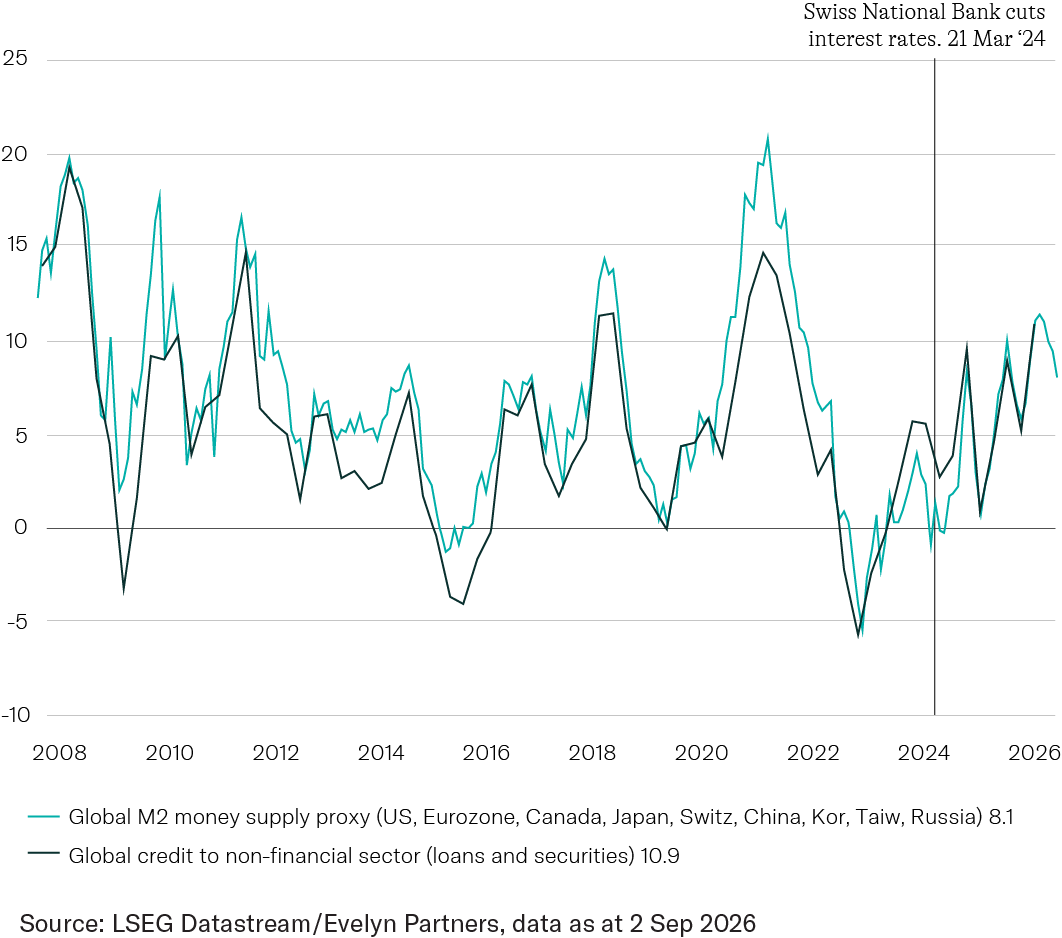
Part of the recent acceleration in credit growth can be traced back to the monetary easing cycle initiated by central banks in 2024. The Swiss National Bank (SNB) was the first to cut interest rates in March, followed by the European Central Bank in June, the Bank of England in August and the Federal Reserve (Fed) in September. While traders in the futures market now expect most central banks to hike interest rates over the coming twelve months or so, those increases are expected to be modest. For instance, traders expect the Fed to hike interest rates by a quarter percentage point once or twice over the next two years.
Looking ahead, demand for credit appears set to remain robust. Large-cap technology companies are increasingly seeking additional financing, alongside their own cash flows, to fund the rollout of data centres and the infrastructure needed to support AI. For example, US AI-related investment-grade corporate bond issuance has totalled $165bn up to the middle of 2026, more than $138bn for the full year 2025.3
Demand for credit also reaches well beyond technology. President Trump has urged Congress to increase US military spending from $1trn to $1.5trn, while Europe has proposed raising defence spending from €200bn to €380bn.4 At the same time, rebuilding oil infrastructure in the Middle East after damage from the US & Israel’s conflict with Iran could create further funding requirements. One example is the UAE’s planned pipeline network to Fujairah, on the Gulf of Oman, designed to avoid the Strait of Hormuz. In addition, many governments are expected to build strategic reserves of energy, fertilisers and essential food commodities to strengthen foreign policy independence. Financing these investments will likely require significant credit.
Banks typically fund themselves through shorter-term deposits and other sources of funding, then use that money to provide loans that are repaid over much longer periods. For example, they use customer deposits and wholesale markets to provide business loans and other forms of longer-term credit. The difference between what banks pay for funding and what they earn from lending is a key driver of profitability.
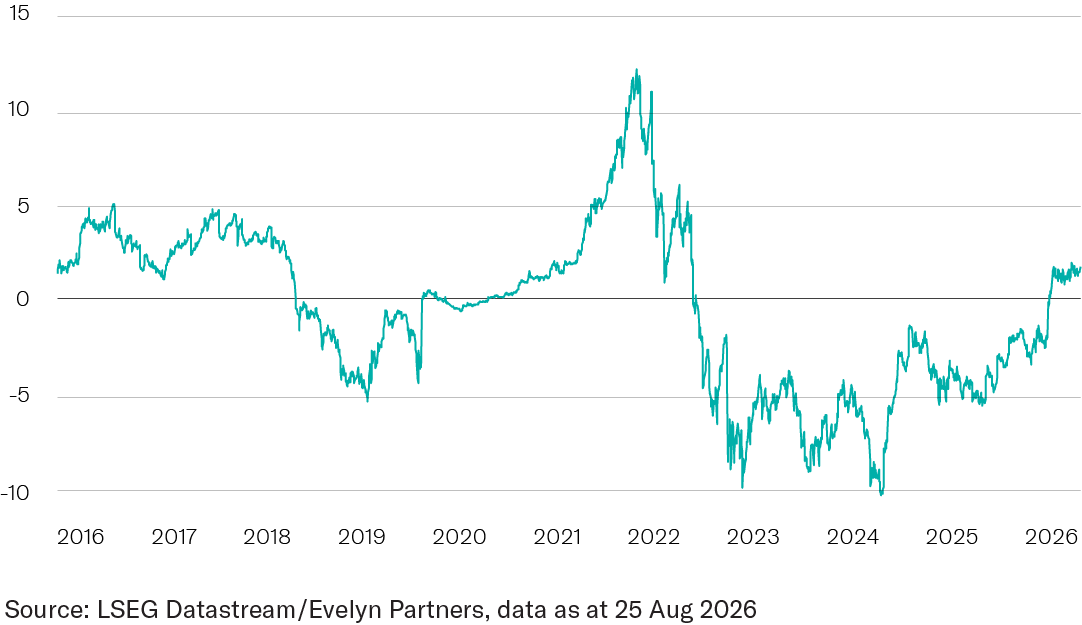
A steepening yield curve occurs when long-term interest rates rise relative to short-term rates, increasing the gap between the two. This matters because banks' funding costs are largely linked to short-term interest rates, while many of the loans issued and bonds they hold are linked to longer-term rates. As this gap widens, banks can potentially earn a higher return on the credit they provide.
Today, the US yield curve measured by the difference between 30-year and 2-year Treasury yield is around one percentage point and has been steepening over the past few years.5 This has occurred alongside a cyclical recovery in US narrow money growth, which measures the growth of cash and readily accessible bank deposits and is a useful cyclical indicator of credit creation and economic activity.
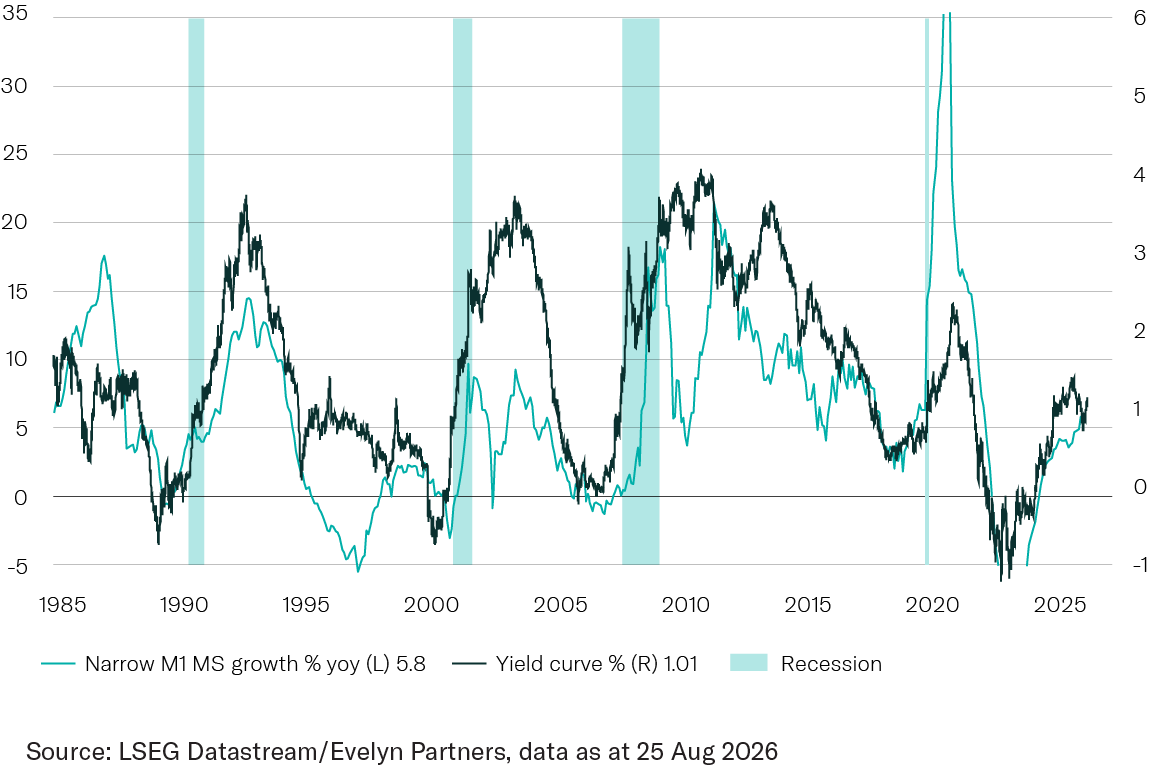
As money growth strengthens, investors typically expect stronger future economic activity and greater borrowing needs, pushing long-term yields higher relative to short-term rates. The result is a steeper yield curve, which can improve banking sector profitability by widening the spread between funding costs and lending rates.
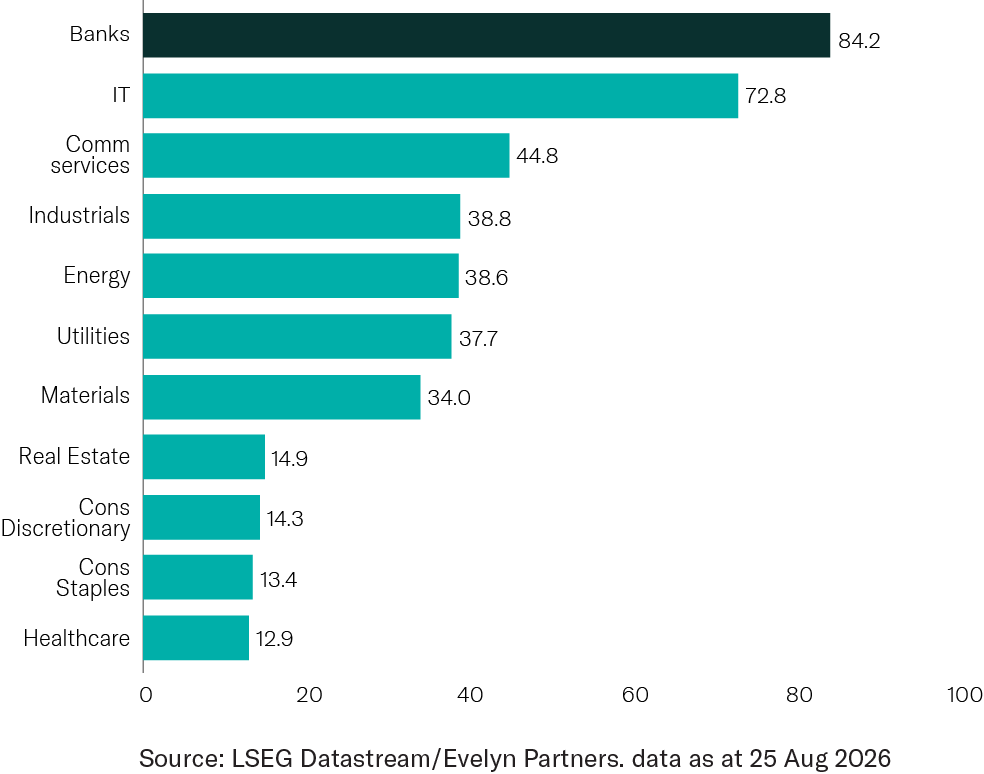
Combined with the broadening demand for credit already discussed, a steepening yield curve should support earnings growth across the banking sector. Improved profitability may also help banks regain market leadership after years in which technology-related stocks dominated investor returns. Indeed, since the Swiss National Bank cut rates in March 2024 to start a new credit cycle, globally listed banks in the MSCI benchmark index have gained 84%, outperforming other major sectors, including information technology and communication services, during that time.6
While the outlook for banks is improving, investors should not ignore a growing source of risk from Japan. For more than two decades, Japan maintained some of the lowest interest rates in the world. This encouraged investors and financial institutions to borrow cheaply in yen and invest the proceeds in higher-yielding assets elsewhere. Known as the "yen carry trade", this became an important source of liquidity for global markets. In simple terms, investors borrowed money in Japan at close to 0% and invested it in assets ranging from government bonds to equities in search of higher returns.
However, the foundations of the carry trade are beginning to unwind. After years of subdued inflation, Japan is experiencing stronger wage growth and rising prices, prompting the Bank of Japan to gradually raise interest rates. Higher rates increase the cost of funding carry trades and raise the risk of investors unwinding positions. Should Japanese investors decide to bring more capital home, or simply reduce the pace of overseas investment, borrowing costs elsewhere could rise materially. This would be particularly challenging at a time when G7 governments face record refinancing needs and large funding requirements.
Indeed, the first coordinated US and Japanese intervention to support the yen in almost 30 years highlighted the importance policymakers are placing on developments in Japanese financial markets. Washington is particularly sensitive to any sharp rise in US Treasury yields, as large-scale selling by foreign investors could further increase government borrowing costs at a time of substantial fiscal deficits.
The implications of any reversal in the yen carry trade extend far beyond Japan. With a net international investment position of approximately US$3.6 trillion, Japan remains one of the world's largest international creditors.7 Decades of overseas investment by Japanese households, institutions and corporations have created a vast pool of capital that helps finance governments, companies and financial markets around the world.
Banks are particularly exposed because sudden rises in government bond yields can increase their funding costs and weigh on the value of their bond portfolios. In other words, the same steepening yield curve that is currently boosting profitability could become a headwind if yields rise too far, too quickly.
For now, rising credit demand and a steeper yield curve remain supportive for banks. However, money rarely stays still for long. The same capital flows supporting bank earnings today could become a source of volatility tomorrow. After all, while money never sleeps, events in Japan may yet give investors and banks a few sleepless nights.
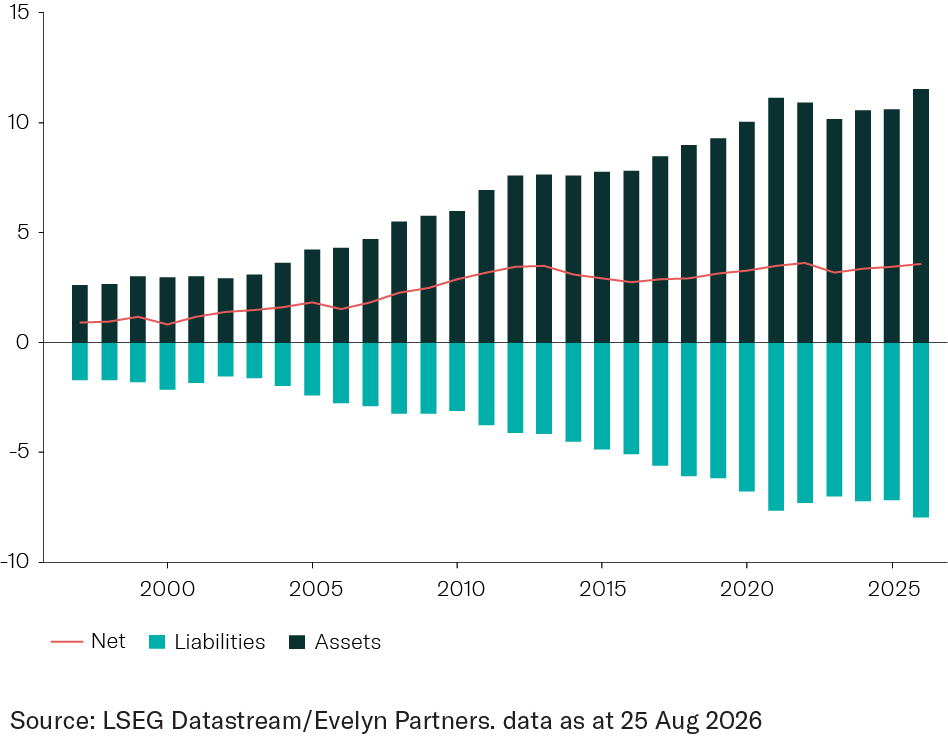
1,2,5,6,7 LSEG/Evelyn Partners
3 Neuberger, How SpaceX and AI Spending Are Reshaping Investment Grade Credit, 10 July 2026
4 Gavekal, Demand and Supply of money, 16 June 2026
Past performance is not a guide to future performance.
Neither MSCI nor any other party involved in or related to compiling, computing or creating the MSCI data makes any express or implied warranties or representations with respect to such data (or the results to be obtained by the use thereof), and all such parties hereby expressly disclaim all warranties of originality, accuracy, completeness, merchantability or fitness for a particular purpose with respect to any of such data. Without limiting any of the foregoing, in no event shall MSCI, any of its affiliates or any third party involved in or related to compiling, computing or creating the data have any liability for any direct, indirect, special, punitive, consequential or any other damages (including lost profits) even if notified of the possibility of such damages. No further distribution or dissemination of the MSCI data is permitted without MSCI's express written consent.
Some of our Financial Services calls are recorded for regulatory and other purposes. Find out more about how we use your personal information in our privacy notice.
Your form has been submitted and a member of our team will get back to you as soon as possible.
Please complete this form and let us know in ‘Your Comments’ below, which areas are of primary interest. One of our experts will then call you at a convenient time.
*Your personal data will be processed by Evelyn Partners to send you emails with News Events and services in accordance with our Privacy Policy. You can unsubscribe at any time.
Your form has been successfully submitted a member of our team will get back to you as soon as possible.


