
The AI opportunity: putting risks in perspective
Circular AI deals are a risk worth watching, but stronger businesses and real demand are keeping the long-term opportunity intact
Circular AI deals are a risk worth watching, but stronger businesses and real demand are keeping the long-term opportunity intact
Artificial intelligence (AI) has faced a more difficult summer in the stock market. Several AI-related shares have fallen sharply after a strong run, although some remain well above their levels a year ago.1 Investors are no longer rewarding every promise; they want evidence that spending on chips and data centres will attract paying customers and generate steady revenues.
This greater scrutiny is healthy. Companies reporting rising sales and profits are being treated differently from those asking investors to wait.
It has also brought a less familiar concern into focus: “circularity”.
The value of an investment, and the income from it, may go down as well as up and you may get back less than you originally invested.
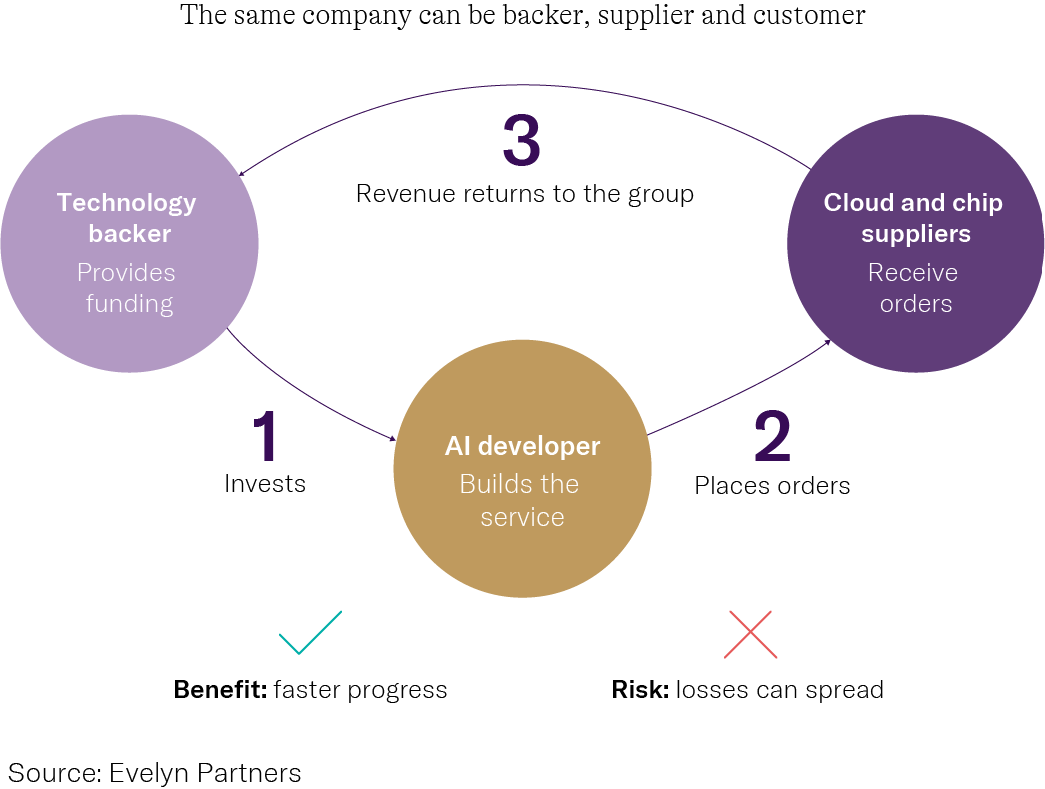
Circularity is an awkward word for a simple arrangement. A technology company invests in an AI developer, which uses some of that money to buy computing power, chips or data-centre space from the investor or its partners. The same company can therefore be an investor, supplier and customer.
Microsoft helped finance OpenAI, which became a major user of its cloud services. Nvidia has invested in developers and computing providers that use its chips. Amazon and Google have backed developers that use their computing services.2
These are real contracts for real services and equipment, so they are not automatically a concern. They can help secure scarce chips, electricity and funding in advance. The risk is dependence: if an AI developer buys less, its supplier could lose both sales and the value of its investment. Circularity can accelerate growth but also spread disappointment more quickly.
The comparison with the technology bubble is worth taking seriously, but the two are not identical. In the late 1990s, telecom companies borrowed heavily to build networks, suppliers helped finance customers and companies bought space on one another’s networks. When demand disappointed, orders, profits and share prices fell together.
Today’s investment has grown unusually quickly. Three years into the current boom, it stood at around 4.5 times its starting level, compared with 1.4 times at the same stage of the dot-com boom.3 That warrants careful monitoring, although speed alone does not tell us whether investment will prove excessive.
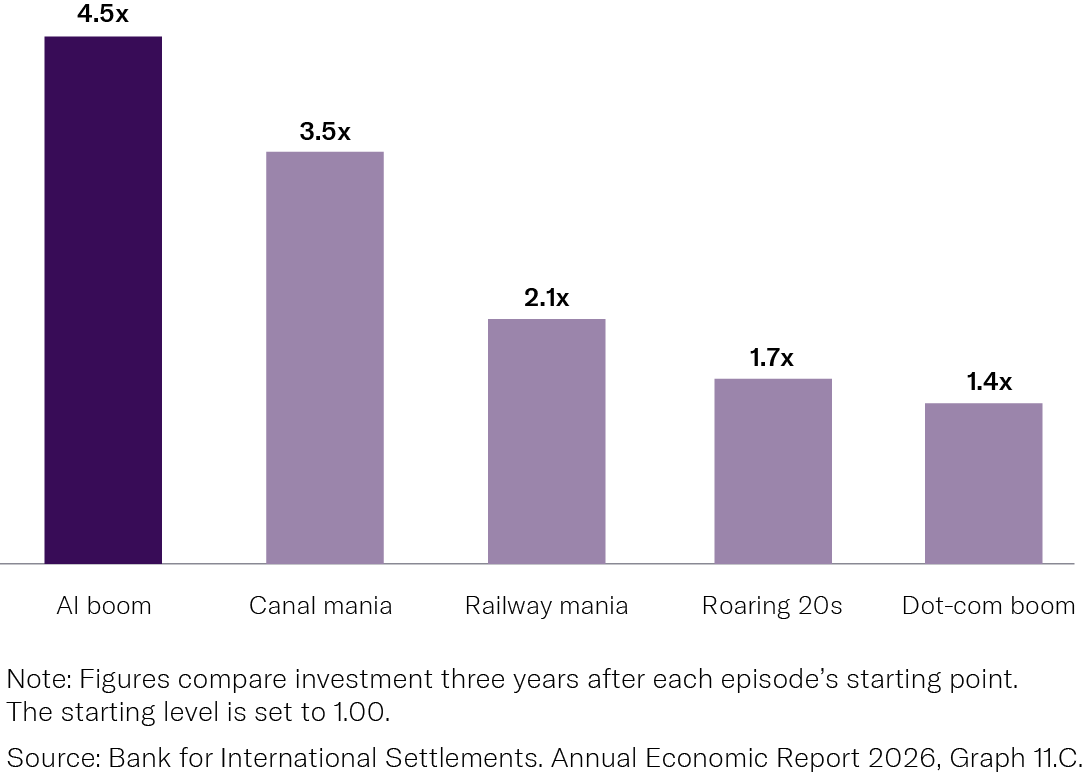
The question is whether today’s investment rests on firmer foundations. So far, there are important differences. During the dot-com bubble, investors often backed businesses with little revenue, no profits and weak balance sheets — an attitude described as “no profits, no problem”. Today’s investment is led by established companies with record profit margins and substantial cash flows, allowing them to fund much of their spending themselves. However, borrowing is growing among data-centre operators and other infrastructure providers, increasing their vulnerability if demand disappoints.
The chart below compares the investment returns of the AI-6 (Alphabet, Amazon, Meta Platforms, Microsoft, Nvidia and Oracle) with the rest of the S&P 500. The gold line shows their profits per share relative to the rest of the S&P 500, while the purple line compares their returns. When either line rises, the AI-6 are pulling further ahead. Both have risen markedly since the mid-2010s, showing that stronger returns have been accompanied by stronger earnings rather than speculation alone. It also illustrates the substantial opportunity cost of avoiding these companies altogether.
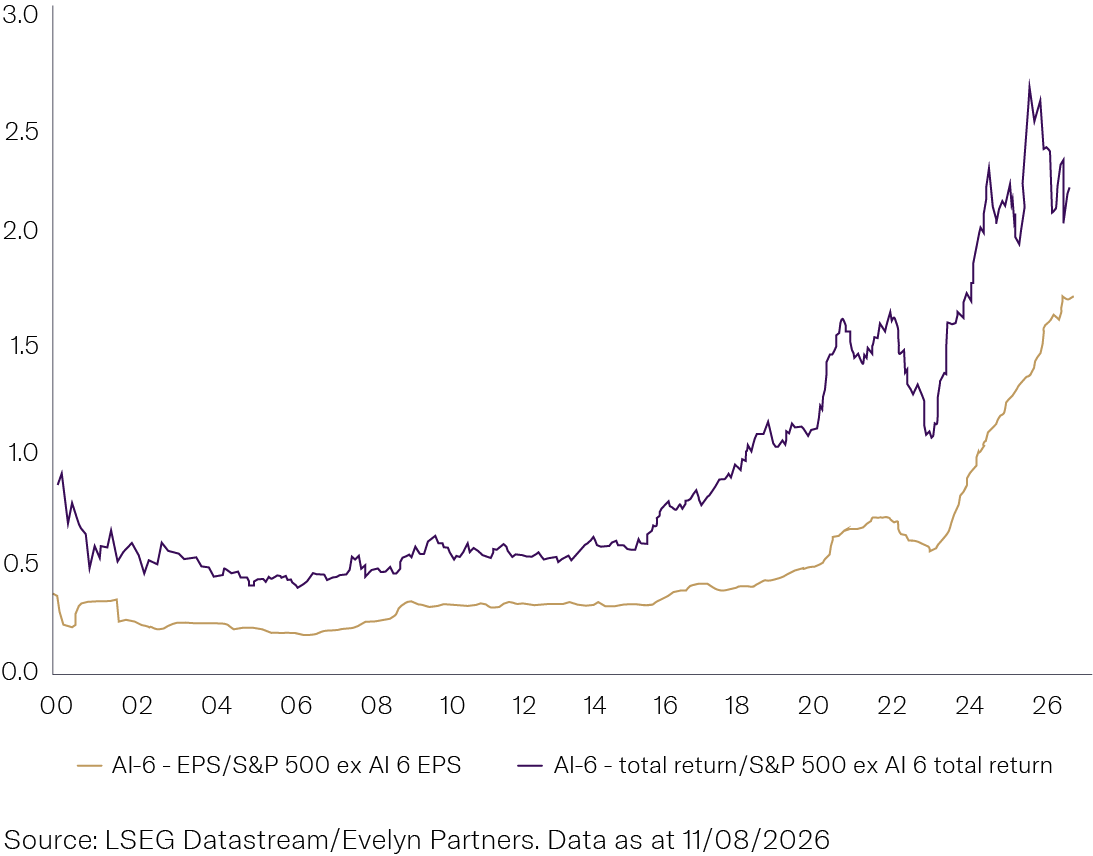
Figures refer to the past and past performance is not a guide to future performance.
Demand remains firm: businesses are still paying relatively high prices to use older AI chips in data centres and access to electricity and advanced chips remains constrained. This does not rule out overinvestment but suggests that current investment is supporting genuine activity.
Recent share-price falls show that investors are marking down companies when spending rises faster than the returns they can reasonably expect. Not every AI promise is being treated equally.
The opportunity is substantial, but the scale and speed of investment leave little room for disappointment. A setback could hurt individual companies; their interconnections and circular links could spread the impact more broadly
We are focused on three main risks:
Demand falls short. OpenAI and Anthropic have made very large commitments to buy computing power. If growth in paying customers disappoints, orders could be delayed or renegotiated. Reliance on only a few developers could spread the impact across suppliers.4
Borrowing and overbuilding increase. More spending is being financed with debt. Data centres take years to build, while interest, electricity and equipment costs do not fall quickly if demand weakens. Facilities could be left underused, with circular links compounding the damage.5
Cheaper competition drives down prices. Chinese and open-source models, often cheaper to use and adapt, could reduce what customers will pay for US-developed services. AI use might keep growing while returns from today’s expensive models and data centres fall.6
To assess these risks, we focus on whether spending by the largest cloud providers is translating into future revenue. We track debt levels, contracted future business relative to company size, and whether customers and business partners have the financial strength to meet their commitments.
So far, the evidence is more reassuring than alarming, although not uniformly so. If demand slows, the first signs are likely to be weaker growth in contracted business, delayed projects and greater pressure on heavily indebted companies and their partners — not necessarily a sudden sector-wide collapse. This is why close monitoring remains important as AI investment continues.
Our view on AI-related investments is in the context of holding them as part of a broadly diversified portfolio across sectors, regions and asset classes, rather than as a standalone investment theme. By 31 July 2026, global information technology shares had returned 15.8% in sterling terms for the year to date. Global energy shares gained 33.8%, while industrials and real estate shares also produced double-digit returns.7
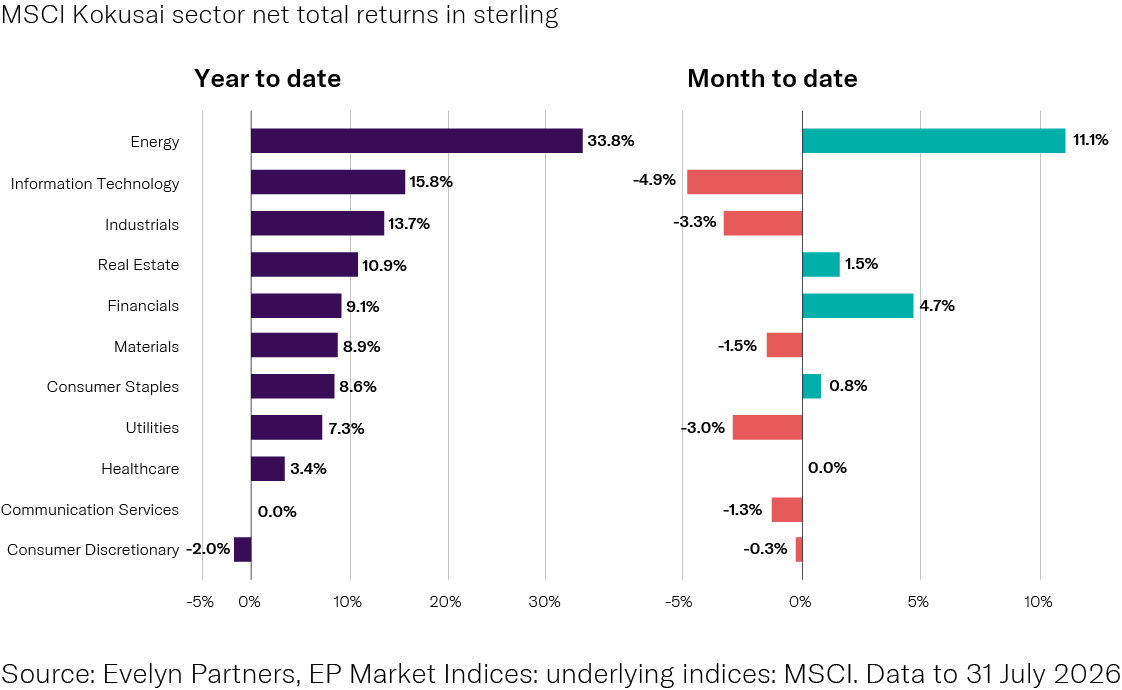
Figures refer to the past and past performance is not a guide to future performance.
July’s pullback illustrates how diversification can help when different parts of the market move in opposite directions. Technology fell 4.9% in the month, while energy rose 11.1%, financials rose 4.7% and real estate rose 1.5%. When market leadership shifts, investments outside the recent winners can provide valuable counterweights.
Our approach blends exposure to cyclical sectors, including AI-linked technology companies, with defensive sectors that may prove more resilient during weaker periods. We also diversify across regions and asset classes. Different types of investment may perform differently as market conditions change, helping to offset weakness elsewhere.
Regular rebalancing — trimming areas that have run ahead and adding to those that have lagged — also helps prevent one successful theme from dominating the portfolio. Diversification cannot fully remove risk, but it reduces reliance on AI leading the market at all times.
We remain positive but watchful. Circularity can magnify setbacks, and not every AI-related company will prosper. Yet avoiding the area altogether could mean missing businesses with strong profits and long-term potential.
Our view on AI-related investments is in the context of holding them as part of a broadly diversified portfolio across sectors, regions and asset classes, rather than as a standalone investment theme. Diversification allows investors to participate in the AI opportunity without depending on it to succeed in every market environment.
1 US technology share-price performance, LSEG Workspace, 2026.
2 A Guide to the Circular Deals Underpinning the AI Boom, Bloomberg, 2026.
3 Progress & Peril, Annual Economic Report 2026, Bank for International Settlements, 28 June 2026.
4 Ahead of IPOs, AI Giants Keep Making Circular Deals. Here’s Why That’s a Risk, Morningstar, 2026.
5 The Second Derivative: Why No One Understands the AI Boom, Groundbreaker, 2026.
6 The 2025 AI Index Report, Stanford Institute for Human-Centered Artificial Intelligence, 2025; DeepSeek-V3 Technical Report, DeepSeek-AI, 2024.
7Evelyn Partners, EP Market Indices; underlying indices: MSCI. Net total returns in pound sterling, data to 31 July 2026.
Some of our Financial Services calls are recorded for regulatory and other purposes. Find out more about how we use your personal information in our privacy notice.
Your form has been submitted and a member of our team will get back to you as soon as possible.
Please complete this form and let us know in ‘Your Comments’ below, which areas are of primary interest. One of our experts will then call you at a convenient time.
*Your personal data will be processed by Evelyn Partners to send you emails with News Events and services in accordance with our Privacy Policy. You can unsubscribe at any time.
Your form has been successfully submitted a member of our team will get back to you as soon as possible.


