
Trump’s midterm misgivings: attention returns to US domestic politics
As US voter and global market anticipation builds ahead of the US midterm elections, we are publishing the first of three articles on this important subject.
As US voter and global market anticipation builds ahead of the US midterm elections, we are publishing the first of three articles on this important subject.
In this first instalment, which acts as a primer, we focus on how these elections work in practice and why they are so important in shaping the political landscape. The second instalment will consider how the Republicans and Democrats have fared in previous midterms and how equity markets have responded. The third and final article will focus on the outcome and implications for both political parties.
November’s midterms will shape the remainder of Trump’s presidency.
Losing the House would significantly constrain Trump’s policy agenda.
Investors should expect increased political noise and volatility in the run-up.
They are national elections held halfway through a president’s four-year term, held this year on 3rd November. While the president is not on the ballot, the election is widely seen as a referendum on his leadership and policies.
In a midterm election, around one third of the 100 Senate seats and all 435 seats in the House of Representatives are contested, meaning control of Congress can shift meaningfully.
The Senate | House of Representatives | |
Elected official: | Senator | Congressman/woman |
Bicameral name: | Upper House | Lower House |
Size and character: | Smaller & often less powerful | Larger with more political influence |
Representation: | 2 senators per state | Population based |
Total seats: | 100 | 435 |
Seats for control: | 51 | 218 |
2026 voting: | 35 seats | All 435 seats |
Legislative powers: | Confirm presidential appointees | Makes Federal Law |
Ratify treaties | Initiates revenue bills | |
Tries impeachment cases | Power to impeach federal officials |
Midterms are seen as a public judgement on the sitting president and their party. As control of the Senate and House can change, the results of the midterms can strongly affect the president’s ability to pursue their agenda, pass laws and approve appointments.
Currently the Republicans control the Presidency, Senate and the House of representatives. If Republicans lose the House, Trump stands to lose a significant degree of control and authority which he has become accustomed to. A Democrat House can stop, slow, or reshape the agenda in three important ways:
Policy agenda disruption
Big-ticket items become negotiated fights where Trump is likely forced to give concessions.
Agenda-setting: Even if the Senate stays Republican, the House can obstruct Trump’s policy agenda
Taxes & spending: Any extensions/changes to tax policy are threatened and spending bills also becoming heavily scrutinised.
Broad policy challenges: potentially across immigration, trade, healthcare, energy, technology.
Increased oversight and scrutiny
When the opposition controls the House, they control committees, subpoenas, hearing calendars and what becomes a scandal-of-the-week. If Trump loses the House, this will likely create:
Constant headline drag: investigations can be politically damaging.
Bureaucratic slowdown: senior officials get pulled into document and testimony preparation, distracting focus away from any core agenda.
Narrative reversal: instead of “Trump’s agenda,” the media frames it “Trump under investigation / administration under scrutiny.”
Investigations and the return of impeachment threats
More investigations demanding documents, official testimony, generate damaging headlines.
House also has sole power to impeach federal officials (including Trump). However, conviction requires a two-thirds Senate vote, which is a high bar
While a divided congress will likely cause political disruption, this doesn’t imply that markets will suffer as a result, history shows broad resilience of equities during US midterms. Political gridlock can be good for markets as it reduces uncertainty, limiting the more extreme policy outcomes.
While there are no certainties here the Republicans look more likely to lose the House, while the Senate is currently a close call. Reviewing an array of public market pollsters (www.270towin.com, www.racetothewh.com, https://www.cookpolitical.com) at the time of writing all forecast the Republicans to lose the House.
All 435 Congressional Districts are at the ballot. The Republican Party currently controls the U.S. House and 218 seats are needed for a majority.
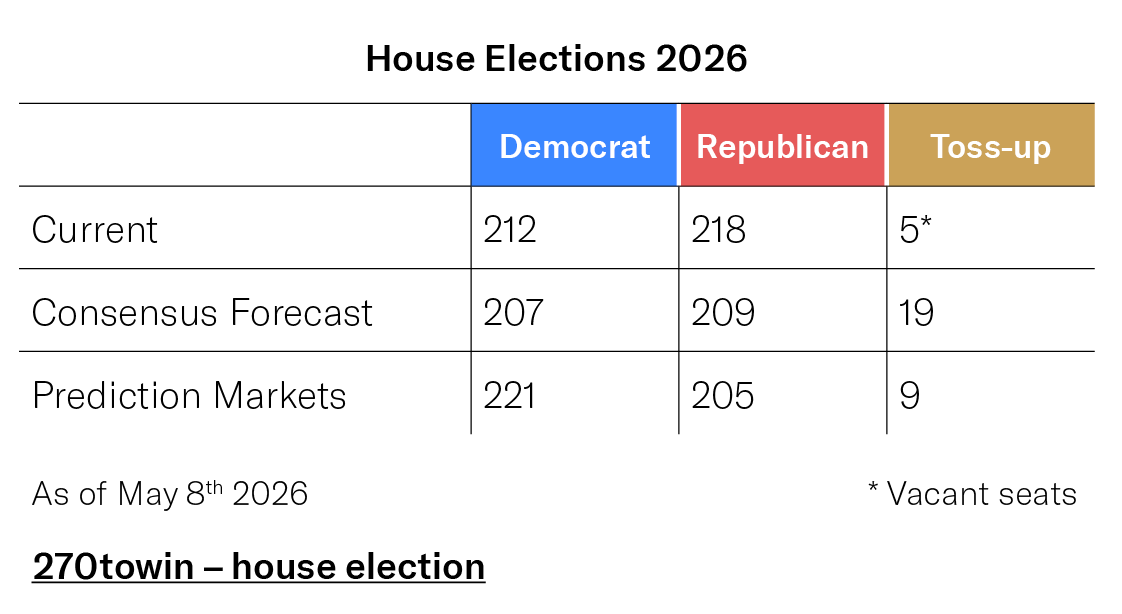
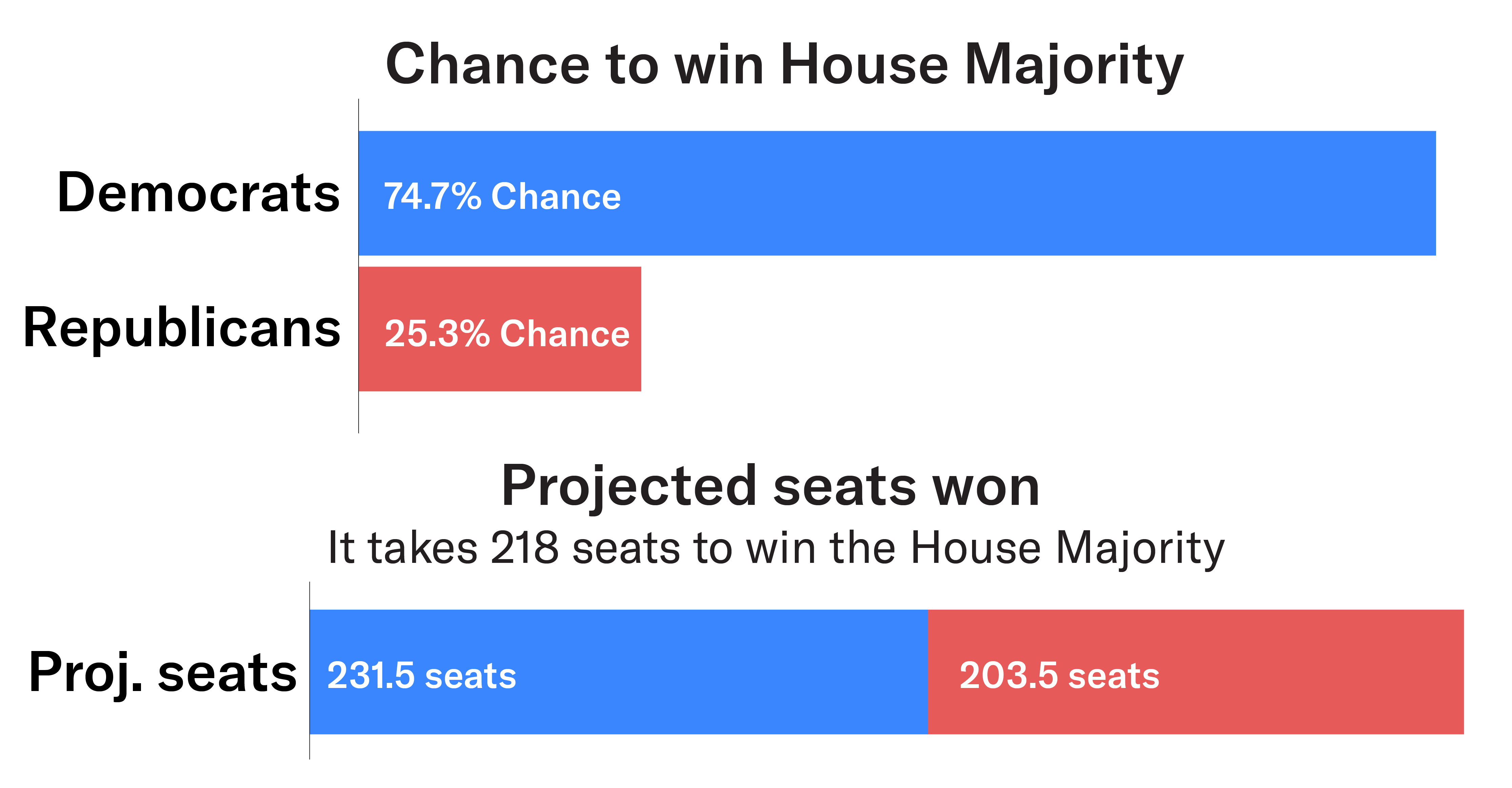
November’s midterm elections look set to be a major test of Trump’s presidency. With current forecasts pointing to a likely Republican loss of the House, the administration may soon face legislative gridlock, intensified scrutiny and a far more combative political environment. Even if the Senate remains Republican, the balance of power in Washington could shift sharply, setting the scene for an even less predictable and more polarised political backdrop.

The Democratic donkey began with opponents mocking Andrew Jackson as a "jackass"; Democrats later embraced the common-man image, reflecting someone that is hardworking and unpretentious - closer to ordinary voters than to elites.
The Republican elephant emerged from an 1874 political cartoon featuring animals by Thomas Nast in Harper’s Weekly. In the cartoon, rumours that President Ulysses S. Grant might seek a third term are treated as a scare story. One of the scared animals was a large, nervous elephant labelled "The Republican Vote." The symbolism was that of size and power simultaneously being capable of panic or clumsiness. The initial negative connotation of an elephant was offset with positive attributes of memory, strength and dignity.
Some of our Financial Services calls are recorded for regulatory and other purposes. Find out more about how we use your personal information in our privacy notice.
Your form has been submitted and a member of our team will get back to you as soon as possible.
Please complete this form and let us know in ‘Your Comments’ below, which areas are of primary interest. One of our experts will then call you at a convenient time.
*Your personal data will be processed by Evelyn Partners to send you emails with News Events and services in accordance with our Privacy Policy. You can unsubscribe at any time.
Your form has been successfully submitted a member of our team will get back to you as soon as possible.


